
Lead management system (LMS) includes all activities and strategies of the marketing and sales team around the sales funnel / lead’s journey. Here you align your team’s activities with the lead and lead’s journey stage.
- The first step is to migrate into a CRM like HubSpot, Salesforce or Pipedrive – here companies can set up their own lead management architecture, however this requires experience and knowledge.
- The second step is usually to hire a CRM agency to help design a customized strategy and its processes.
- However to truly run a self-regulating, dynamic LMS it requires a data-driven, holistic scoring system as the glue behind it, that sends leads further and backwards/ enrolls them in the right action at the right time. Here you can use a predictive lead scoring set up like ours or create your own manual HubSpot lead scoring system or one of your liking.
How alignment can take shape
Each lifecycle stage can now be aligned to a scoring value filter e.g. between 5-20, together with custom criteria for stages beyond the MQL one. For example for the MQL one we filter additionally to the scoring subset also for minimum, disqualification and time-based recency criteria. This ensures that no spam gets sent further and that the leads have a fit and an interest as well as a warm temperature. For the SQL + stages, scoring is more relevant for the automated lead activities than the lifecycle stage definition – e.g. customers are defined by their purchase not by their score which can identify their potential churn danger or co-marketing interest. This LMS attention to detail increases the chance of influencing the lead towards conversion and thereby subsequently increases the general conversion rate of the whole pipeline over time. Qualification and identification are critical day-to-day scoring implementation reasons.
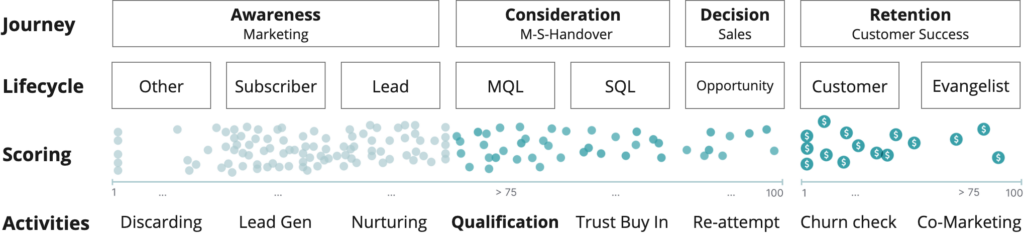
Step-by-step LMS implementation system
- Run a dynamic system: scoring or/and a rule system that dualistically moves leads forward or backward through the lead funnel.
- Implement it in your workflow enrollment with each lifecycle stage and ensure to nurture them with the content that fits their journey stage instead of having them send too advanced or too easy content for their stage.
- Set up discarding and disqualification criteria for contacts that have no conversion interest and align them with the other stage in HubSpot for example, here you can use subtags eg in a custom property.
- Check all enrollments holistically: Ensure you run aligned workflow enrollment rules and goals so the system does not suffer from simultaneous workflow enrollments. So visualize all lifecycle stage enrollment and unenrollment criteria first.
- Set up short tracking rules to allow a jump in stages like after a contact form submission with a product interest, this one should be sent directly to sales. Same could be set up diametrically if an email bounces etc.
- Set up the lead activities enrollment criteria as well (see above diagram). Here a lifecycle stage can have multiple activities aligned – eg MQL (sent to sales, disqualified by sales, re-engagement after closed lost) or lead nurturing could be segmented by the buyers center role or lead behaviour sub score.
- Set up lead management reporting to stay up to date with funnel times and conversion rates to anticipate and prevent bottlenecks.
- Optionally segment your lead activities set up by lead sources. This ensures more flexibility in the steps e.g. an outbound might need a demo while an inbound already gathered that information by themselves.
Architecture pitfalls
Setting up a CRM architecture includes many variables or dimensions (sources, objects, buyer roles etc) that should in the best case align your commercial teams while getting the lead further through the funnel (activities). Yet in reality it can also complicate the activities, especially the bigger the organization or the higher the amount of workflows. Therefore simplicity is key in documentation and visualization. It also shouldn’t become a gated system where someone always has to contact a keyholder for applying small changes.
In Conclusion:
To run a dynamic lead management system it is essential to align the lead lifecycle stages with dynamic dualistic en- and unenrollment criteria (e.g. scoring). This attention to detail can become the backbone of an organization’s total lead architecture and a critical component to its sales activities and success. After mapping out your architecture, go the next step and reach out to us for strategy consultancy.
